In this lesson, we read about where the students stay at home and have their lessons on the radio. Some vocabulary we learned:
air --> what is all around us, what we breathe, what we need to live
the air -->the radio. Invisible radio waves travel through air to your radio so you can hear the news and music.
You are on the air. -> You are on the radio.
Then, we made a word web. We brainstormed all the words we could think of that had to do with school:
SCHOOL: quiz / think / IQ / computer / cafeteria / book / notebooks / lessons / pens / pencils / eraser / bag / backpack / ruler / homework / listen / teacher / weekends / write / students / exercise / school days / tests / learn
Finally, we read the article "School of the Air", and talked about some difficult vocabulary:
resources --> a source of supply or aid to help you accomplish something (resources include things like a computer, the internet, books, pens, pencils, paper, people, etc)
prepare --> get ready for something. Teachers prepare lessons. Students prepare for a test.
communicate --> talk with someone through talking, writing, etc.
fax --> like a big telephone that allows you to send documents (letters)
strange --> different or weird
isolated --> very remote; far from other people.
attend --> go to
Next time: we will re-read the article "School of the Air" and we will talk about it some more.
Sunday, October 31, 2010

Monday, 01 November, 2010: A1 Class
In this lesson, we looked at page 14 in our textbook. We reviewed the problems that Sally, Danny, and Tome have:
Sally is desperate because she has tried all the diets and does not know how to lose weight.
Danny is lonely because he does not fit in at school.
Tom is shy because he is afraid of making a fool of himself.
Then, we talked about advice we could give to Sally, Danny, or Tom. After we gave our own idea for advice, we read an email to Sally in our textbook. We talked about the advice and we looked at specific sentences that introduce advice and reasons for the advice:
Sentences to introduce advice:
What you should do is eat a healthy diet.
You could exercise more.
Sentences to introduce justifications/reasons:
If you do this, you'll soon lose weight.
That way, you'll burn calories.
Then, we talked about opening remarks and closing remarks:
opening remarks --> the things you write at the beginning of an email or letter
closing remarks --> the things you write at the end of an email or letter
Finally, we read part of a letter from a pen friend and we worked in pairs to brainstorm advice we could give this friend.
Don't forget your homework!
Write a reply to the pen friend we were talking about at the end of class. Give advice and give your reasons for that advice. Don't forget to include opening remarks, a main body, and closing remarks!
Sally is desperate because she has tried all the diets and does not know how to lose weight.
Danny is lonely because he does not fit in at school.
Tom is shy because he is afraid of making a fool of himself.
Then, we talked about advice we could give to Sally, Danny, or Tom. After we gave our own idea for advice, we read an email to Sally in our textbook. We talked about the advice and we looked at specific sentences that introduce advice and reasons for the advice:
Sentences to introduce advice:
What you should do is eat a healthy diet.
You could exercise more.
Sentences to introduce justifications/reasons:
If you do this, you'll soon lose weight.
That way, you'll burn calories.
Then, we talked about opening remarks and closing remarks:
opening remarks --> the things you write at the beginning of an email or letter
closing remarks --> the things you write at the end of an email or letter
Finally, we read part of a letter from a pen friend and we worked in pairs to brainstorm advice we could give this friend.
Don't forget your homework!
Write a reply to the pen friend we were talking about at the end of class. Give advice and give your reasons for that advice. Don't forget to include opening remarks, a main body, and closing remarks!
Monday, 01 November, 2010: A3 Class
In this lesson, we reviewed the question structure "Who is [PERSON]?" and how to answer this question:
Who is Peter's [grandmother]?
Peter's [grandmother] is [Jean].
Be careful, because even though there is an 's at the end of "Peter", it does not mean is. This 's is used to show possession or relationship:
Peter's grandmother =/= Peter is grandmother
Peter's grandmother = the grandmother of Peter
We talked aboutwords to describe people:
dark hair --> hair that is brown, dark brown, or black
fair hair --> hair that is blond or red
blond hair --> hair that is "yellow"
red hair --> hair that is kind of orange
grey hair --> hair that looks anywhere from white to grey to silver, but we always only say "grey"
beard --> the hair that grows on a man's chin
moustache --> the hair that grows on a man's lip
Also, please be careful when talking about people's eyes. We never say "black eyes", even if the eyes are very dark. We always say "brown eyes" instead:
I have black eyes. (wrong)
I have brown eyes. (correct)
Who is Peter's [grandmother]?
Peter's [grandmother] is [Jean].
Be careful, because even though there is an 's at the end of "Peter", it does not mean is. This 's is used to show possession or relationship:
Peter's grandmother =/= Peter is grandmother
Peter's grandmother = the grandmother of Peter
We talked aboutwords to describe people:
dark hair --> hair that is brown, dark brown, or black
fair hair --> hair that is blond or red
blond hair --> hair that is "yellow"
red hair --> hair that is kind of orange
grey hair --> hair that looks anywhere from white to grey to silver, but we always only say "grey"
beard --> the hair that grows on a man's chin
moustache --> the hair that grows on a man's lip
Also, please be careful when talking about people's eyes. We never say "black eyes", even if the eyes are very dark. We always say "brown eyes" instead:
I have black eyes. (wrong)
I have brown eyes. (correct)
 |
| Beards |
 |
| Moustaches |
Scholarship Information for International Students to Study Abroad
Now is the time to start thinking about your future! I know many of you are planning on going to university after high school. I know that many of you are planning on attending universities in Mongolia, but I've heard a couple of students say that they want to study abroad, so I did just a (very little bit of) research and I found to websites to help you start looking at scholarship information:
Scholarship information for CANADA
Scholarship information for USA
Of course, this is just to help you get started, and it would be a good idea to check the websites of the schools you are interested in attending to see if there are other scholarship opportunities which are not listed on these websites or to keep your eyes (and ears) open for scholarships from within Mongolia to send Mongolian students abroad to study.
Also,if you have a question about studying in Canada or about university in general (such as what is university like, how should you study, what should you study, etc), don't be shy! You can ask me, and I will do my best to give you the answers you need. If I don't know the answer to your question, I will do my best to help you find the answer!
Scholarship information for CANADA
Scholarship information for USA
Of course, this is just to help you get started, and it would be a good idea to check the websites of the schools you are interested in attending to see if there are other scholarship opportunities which are not listed on these websites or to keep your eyes (and ears) open for scholarships from within Mongolia to send Mongolian students abroad to study.
Also,if you have a question about studying in Canada or about university in general (such as what is university like, how should you study, what should you study, etc), don't be shy! You can ask me, and I will do my best to give you the answers you need. If I don't know the answer to your question, I will do my best to help you find the answer!
Discussion Topics: Clothes and Character
1) Who buys your clothing? Where do your clothes come from?
2) Is your taste in clothes similar to your parents' taste in clothes?
3) Name some famous shoe brands. Do you wear any of these? What is your favourite style of shoe? What do you think is the most fashionable brand of shoe?
4) Name some famous jeans. Do you wear any of these? Do you find jeans comfortable? What is the most amount of money you would spend on a pair of jeans?
5) If two pairs of shoes were identical, what would be mroe important in deciding what to buy: cost or brand?
6) Do you think fashionable brands are worth their high price?
7) What are the most important concerns in choosing what to wear?
8) Do you think that you will change your style when you enter university or enter the workforce?
9) Does being cool depend on wearing certain brands?
10) Would you wear clothes or a style that you do not find attractice just because it is trendy?
11) What is more important: chracter or celebrity?
12) What is more important: wearing name-brand clothes or having a good personality?
13) What are the most important aspects of having a good personality?
14) Who is the best-dressed person in your class?
15) Who has the best personality in your class?
2) Is your taste in clothes similar to your parents' taste in clothes?
3) Name some famous shoe brands. Do you wear any of these? What is your favourite style of shoe? What do you think is the most fashionable brand of shoe?
4) Name some famous jeans. Do you wear any of these? Do you find jeans comfortable? What is the most amount of money you would spend on a pair of jeans?
5) If two pairs of shoes were identical, what would be mroe important in deciding what to buy: cost or brand?
6) Do you think fashionable brands are worth their high price?
7) What are the most important concerns in choosing what to wear?
8) Do you think that you will change your style when you enter university or enter the workforce?
9) Does being cool depend on wearing certain brands?
10) Would you wear clothes or a style that you do not find attractice just because it is trendy?
11) What is more important: chracter or celebrity?
12) What is more important: wearing name-brand clothes or having a good personality?
13) What are the most important aspects of having a good personality?
14) Who is the best-dressed person in your class?
15) Who has the best personality in your class?
Vocabulary
It is time for twelve new vocabulary words. Challenge yourself to learn them, use them when speaking in English with your teacher and with your friends, and use them in your writing!
phantasm (N. Adj: phantasmal) something apparently seen, but without any true physical presence; an illusion of the brain; a ghost or spirit
Despite the reaction from others, Paula wasn't sure if she was experiencing a real explanation for what had happened, or just a phantasm of her imagination.
semblance (N. Adj: semblable) outward appearance; a representation or a copy of something else
Although the students were very excited, the principal was able to get them into some semblance of order.
short-lived (Adj.) living or lasting only a short while; fleeting
The team's two-point lead was short-lived, for soon the other team got two baskets in a row.
transient (Adj.) passing in time, remaining or existing only briefly
When I was growing up, my family led a transient life.
transient (N.) one who passes through without permanent bonds
When I was growing up as a transient, we moved to a new place every two or three years.
transiently (Adv.) moving from place to place fairly often
The homeless person lived transiently, one night at a shelter and other nights flopping with a friend.
whimsy (N. Adj: whimsical Adv: whimsically) a whim or an odd or fanciful idea; sometimes a quaint or unorthodox idea.
Acting upon mere whimsy, Francis went to talk to the principal, and his plans were, surprisingly, approved.
contingent (Adj. N: contingency) (1) liable to occur, but not with certainty; possible, (2) dependent on conditions or occurrences not yet established
(1) Today's weather forecast includes a contingent chance of showers by evening.
(2) My cousin is a contingent worker; she works for a temporary employment agency.
episodic (Adj. Adv: episodically) relating to or happening in episodes
The made-for-television movie was episodic; that is, it was broadcast in sections rather than all in one night.
incidental (Adj. Adv: incidentally) apt to occur in a minor or unpredictable manner
It was an incidental bother; only rarely did the turn signal stick while I was driving.
intermittent (Adj. N: intermittence Adv: intermittently) stopping and starting at intervals
The news about the disaster was intermittent; the network fed the public information only a little at a time.
interrupt (V. Adj: interrupted N: interruption) to break the rhythm or continuity; to stop the momentum or continuum
Because of the lightning, the officials had to interrupt the game.
oscillate (V. N: oscillation Adj: oscillating) to move back and forth; to waver or doubt a decision
Amy was accepted to both Harvard and Yale and she oscillated between the two for a couple of weeks before she made her decision.
periodic (Adj. Adv: periodically) chracterized by a repeating cycle or repetition of intervals; appearing or occurring from time to time
Her visits to her grandmother are periodic. Although there is no formal agreement between them, she visits nearly every other weekend.
phantasm (N. Adj: phantasmal) something apparently seen, but without any true physical presence; an illusion of the brain; a ghost or spirit
Despite the reaction from others, Paula wasn't sure if she was experiencing a real explanation for what had happened, or just a phantasm of her imagination.
semblance (N. Adj: semblable) outward appearance; a representation or a copy of something else
Although the students were very excited, the principal was able to get them into some semblance of order.
short-lived (Adj.) living or lasting only a short while; fleeting
The team's two-point lead was short-lived, for soon the other team got two baskets in a row.
transient (Adj.) passing in time, remaining or existing only briefly
When I was growing up, my family led a transient life.
transient (N.) one who passes through without permanent bonds
When I was growing up as a transient, we moved to a new place every two or three years.
transiently (Adv.) moving from place to place fairly often
The homeless person lived transiently, one night at a shelter and other nights flopping with a friend.
whimsy (N. Adj: whimsical Adv: whimsically) a whim or an odd or fanciful idea; sometimes a quaint or unorthodox idea.
Acting upon mere whimsy, Francis went to talk to the principal, and his plans were, surprisingly, approved.
contingent (Adj. N: contingency) (1) liable to occur, but not with certainty; possible, (2) dependent on conditions or occurrences not yet established
(1) Today's weather forecast includes a contingent chance of showers by evening.
(2) My cousin is a contingent worker; she works for a temporary employment agency.
episodic (Adj. Adv: episodically) relating to or happening in episodes
The made-for-television movie was episodic; that is, it was broadcast in sections rather than all in one night.
incidental (Adj. Adv: incidentally) apt to occur in a minor or unpredictable manner
It was an incidental bother; only rarely did the turn signal stick while I was driving.
intermittent (Adj. N: intermittence Adv: intermittently) stopping and starting at intervals
The news about the disaster was intermittent; the network fed the public information only a little at a time.
interrupt (V. Adj: interrupted N: interruption) to break the rhythm or continuity; to stop the momentum or continuum
Because of the lightning, the officials had to interrupt the game.
oscillate (V. N: oscillation Adj: oscillating) to move back and forth; to waver or doubt a decision
Amy was accepted to both Harvard and Yale and she oscillated between the two for a couple of weeks before she made her decision.
periodic (Adj. Adv: periodically) chracterized by a repeating cycle or repetition of intervals; appearing or occurring from time to time
Her visits to her grandmother are periodic. Although there is no formal agreement between them, she visits nearly every other weekend.
Halloween Riddle #7
It may be Monday, 01 November in Mongolia, but it's still Halloween in Canada (where I come from), so here is my very last Halloween riddle:
Why didn't the skeleton cross the road?

Why didn't the skeleton cross the road?

Saturday, October 30, 2010

Friday, October 29, 2010
Saturday, 30 October, 2010: A2 Class
In this lesson, we read an email in our textbook from Grace about her summer job. Some vocabulary from this lesson is:
theme park --> an amusement park (the park with the roller coaster, ferris wheel, and tilt-a-whirl)
entrance --> where you entre a building, market, park, museum, etc. If you have to pay a fee to enter, the entrance is where you will pay (Tugsbayer suggested it might be KACC in Mongolian, and Ithink that's possible, because that is where you pay, but I wonder if KACC might just mean something like "cashier")
gift shop --> where you can buy souvenirs and gifts to remember a place you visited (such as an amusement park, a museum, etc)
cheerful --> very happy and positive all the time
outgoing --> not shy; not afraid to meet and talk to people
opening remarks (in a letter or email) --> the things we say at the beginning of an email or letter when we are just starting to write
closing remarks (in a letter or email) --> the things we say at the end of an email or letter when we are finishing up and about to end it.
Below are a few images of amusement parks and popuplar amusement park rides:
theme park --> an amusement park (the park with the roller coaster, ferris wheel, and tilt-a-whirl)
entrance --> where you entre a building, market, park, museum, etc. If you have to pay a fee to enter, the entrance is where you will pay (Tugsbayer suggested it might be KACC in Mongolian, and Ithink that's possible, because that is where you pay, but I wonder if KACC might just mean something like "cashier")
gift shop --> where you can buy souvenirs and gifts to remember a place you visited (such as an amusement park, a museum, etc)
cheerful --> very happy and positive all the time
outgoing --> not shy; not afraid to meet and talk to people
opening remarks (in a letter or email) --> the things we say at the beginning of an email or letter when we are just starting to write
closing remarks (in a letter or email) --> the things we say at the end of an email or letter when we are finishing up and about to end it.
Below are a few images of amusement parks and popuplar amusement park rides:
 |
| An amusement park |
 |
| Ferris Wheel |
 |
| Merry-go-round |
 |
| Roller Coaster (in Marie's Home Town!) |
 |
| Swing of the Century |
 |
| Swing of the Century |
 |
| Viking Ship |
 |
| Marie's Favourite-- the Tilt-A-Whirl |
Saturday, 30 October, 2010: A1 Class
This was the class in which we were all supposed to bring in special photos and share a story about them. Only half the class brought in pictures, but that's okay, because I made the rest of the students tell a story or answer an open-ended question about themselves, so we all had a chance to speak. Some vocabulary that came up in this class was:
Octoberfest --> a German holiday that involves drinking a lot of beer.
spelling bee --> a spelling competition
spelling celebration --> a Mongolian celebration when a child learns his or her ABCs
about/around --> we can say "about" or "around" to talk about approximate age, eg. I was about two in this picture. We stop receiving gifts for children's day when we are around eighteen.
teenager --> someone who is between thirteen and nineteen years old
trend --> something that happens alot; something that is cool to do
vacation --> a holiday
sausages --> meat which is linked together in casings, like this:
 I also found this picture when I googled "sausages", and it's so strange, I think I'll share it here, too:
 I also promised Zugi that I would post some popular economics books which I enjoy. Here they are:
The Undercover Economist (Tim Harford)
Freakonomics (Levitt and Dubner)
Superfreakonomics (Levitt and Dubner)
The Black Swan (Nassim Nicholas Taleb)
Fooled by Randomness (Nassim Nicholas Taleb)
The Armchair Economist (Steven E. Landsburg)
Predictably Irrational (Dan Ariely)
At the end of the class, we had a few minutes left, so I taught the students how to play MASH, which is a game I used to play with my friends when I was young. Some vocabulary words that came up when I was explaining the game of MASH were:
mansion --> a really big, fancy house where very rich people live
shack -> a really small, run-down house where very poor people live
UFO --> the spaceship that an alien drives (Unidentified Flying Object)
unidentified --> This is an amalgamation of words:
unIDENTIFied --> to "identify" something means to figure out what it is.
unIDENTIFIED --> if something is identified, you already know what it is.
UNIDENTIFIED --> something which you do not know what it is.
 We played MASH to figure out what kind of house we'll live in, what job you'll have, what car you'll drive, and how many children you will have, but the traditional way to play MASH is to find out who you will marry when you grow up.

Octoberfest --> a German holiday that involves drinking a lot of beer.
spelling bee --> a spelling competition
spelling celebration --> a Mongolian celebration when a child learns his or her ABCs
about/around --> we can say "about" or "around" to talk about approximate age, eg. I was about two in this picture. We stop receiving gifts for children's day when we are around eighteen.
teenager --> someone who is between thirteen and nineteen years old
trend --> something that happens alot; something that is cool to do
vacation --> a holiday
sausages --> meat which is linked together in casings, like this:

The Undercover Economist (Tim Harford)
Freakonomics (Levitt and Dubner)
Superfreakonomics (Levitt and Dubner)
The Black Swan (Nassim Nicholas Taleb)
Fooled by Randomness (Nassim Nicholas Taleb)
The Armchair Economist (Steven E. Landsburg)
Predictably Irrational (Dan Ariely)
At the end of the class, we had a few minutes left, so I taught the students how to play MASH, which is a game I used to play with my friends when I was young. Some vocabulary words that came up when I was explaining the game of MASH were:
mansion --> a really big, fancy house where very rich people live
shack -> a really small, run-down house where very poor people live
UFO --> the spaceship that an alien drives (Unidentified Flying Object)
unidentified --> This is an amalgamation of words:
unIDENTIFied --> to "identify" something means to figure out what it is.
unIDENTIFIED --> if something is identified, you already know what it is.
UNIDENTIFIED --> something which you do not know what it is.


Saturday, 30 October, 2010: A3 Class
In this class, again, Altantogos was the only one who did her homework. She is two for two (that means that two times in a row, she is the only student in the entire class who did her work). I promised that if it happened again, I would give Altantogos a special treat.
For the rest of the class, we reviewed family words. We did this by having individual students come up and draw their family tree on the board. Then, we had the rest of the class ask questions about the family trees. For example:
Who is Alegsandra?
She is my second cousin.
For the rest of the class, we reviewed family words. We did this by having individual students come up and draw their family tree on the board. Then, we had the rest of the class ask questions about the family trees. For example:
Who is Alegsandra?
She is my second cousin.

Thursday, October 28, 2010
Friday, 29 October, 2010: Grades 1 and 2, and B1, B2, and B3 Classes
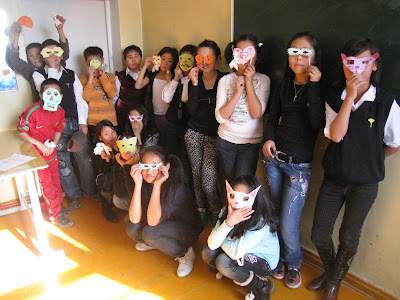
This was our final lesson before Halloween, so we had a Halloween craft lesson. All grades made ghosts out of Kleenex. Grades 1 and 2 made construction paper Jack-o-lanterns, while B1, B2, and C3 classes made masks. Here are a few photos from the day, and see the slideshow on the right sidebar for more photos. The slideshow only shows 110 photos, but I have 220 photos, in all. Click on any one of the photos to see a bigger copy of the picture, and to see all the photos. Thanks.




Wednesday, October 27, 2010
Thursday, 28 October, 2010: A1, A2, C1, and C2 Classes
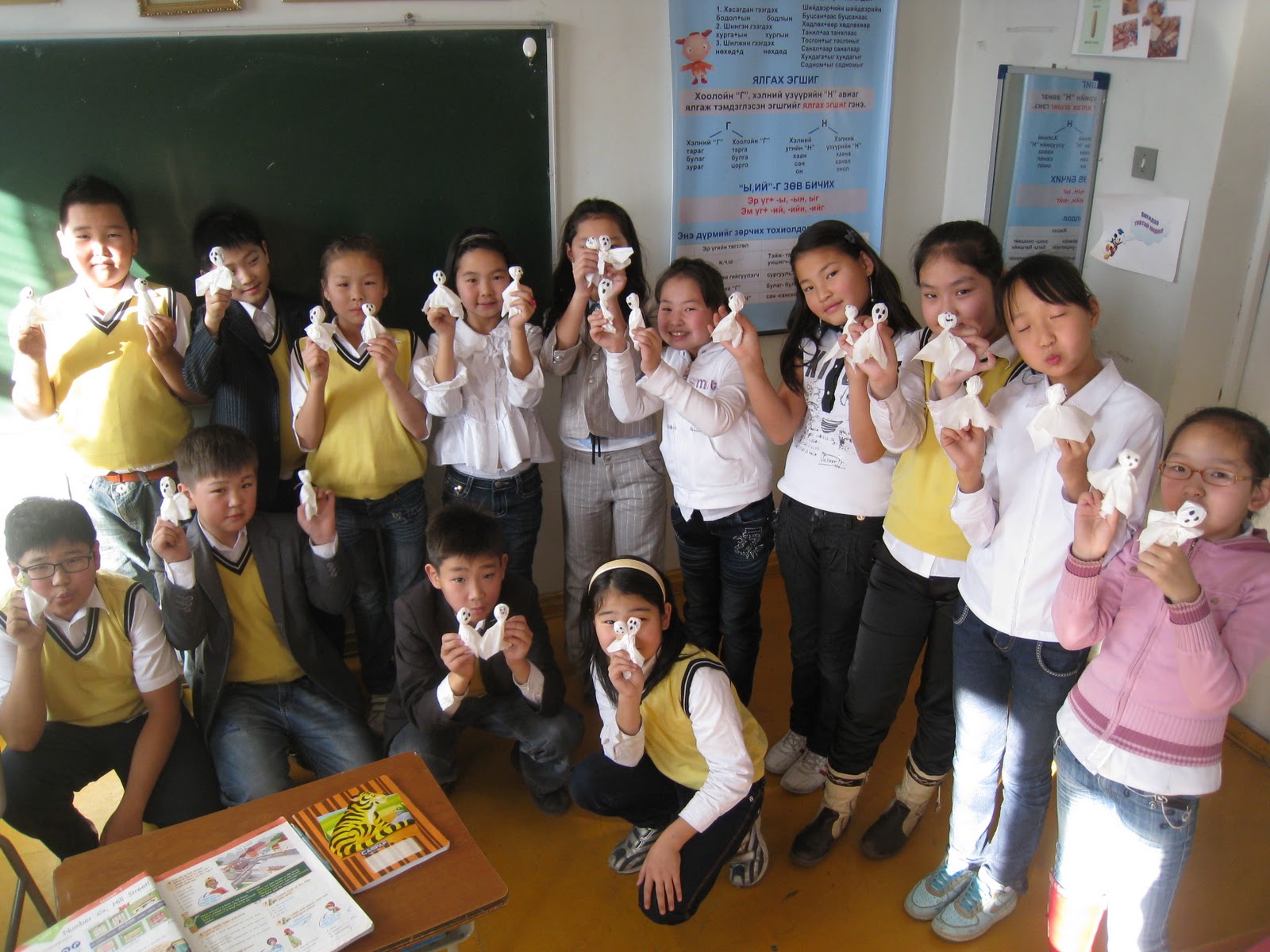
Today, our last lesson together before Halloween, was a Halloween craft lesson. We made ghosts out of Kleenex (and toilet paper, when my Kleenex supply ran low), and we also made Halloween masks out of coloured paper. Here are some photos of the Halloween Craft lesson we had. I took a lot more photos than just these, though (see the slideshow on the right-side bar). I know the pictures in the slideshow are small, but if you click on any one of the photos in the slideshow, you will be able to see a bigger version of the pictures.




Tuesday, October 26, 2010
Wednesday, 27 October, 2010: A3 Class
In this lesson, I tried to check your homework from last time, and found that only one person had completely done the homework (congratulations, Altantogos, for doing all the homework!) and only one other person had even half finished the homework (thank you, Khulan, for doing some of the homework). This led Marie to tell you about the plan for next term: for this first term, you were lucky because there were no grades in my class, but for next term, I will be giving you guys grades based on class participation (bringing your notebooks/books to class, taking notes, listening to the lesson, following instructions), homework (whether your homework is done and complete), tests (you will have some tests next term), and assignments (I will give one or two assignments), so hopefully this will be enough of an incentive for you to take English class a little more seriously next semester.
Then, we moved on and started talking about family trees. We looked at a family tree in our textbook of a boy named Peter, and we talked about Peter's family (Who is Peter's grandmother? Who's Caroline? etc). Then, for fun, Marie drew her enormous family tree on the chalkboard, we found that Marie has 22 aunts and uncles, 33 cousins, and about 33 second cousins, as well.
We also looked at some family riddles:
My sister is my mother's daughter.
My father is my grandfather's son.
My mother is my father's wife.
My uncle is my aunt's husband.
This reminded Marie of a riddle in a short story called "Juan Verdades", by Joe Hayes. In this story, Juan Verdades, an extremely honest character, picks all of the apples from his boss's prize apple tree and gives them away to the girl he loves. When it comes time to admit to his boss what he did, here is what he says:
"A fool picked the apples and gave them away. The fool is my father's son. If the fool had a child, he would call his father "grandfather". I don't have any brothers."
Challenge: Can you figure out this family riddle? Who is the fool? Is it:
a) the speaker?
b) the person being spoken to?
c) the father?
d) some other person we don't know about?
Don't forget your homework!
Remember the enourmous family tree Marie showed you? Well, now it's your turn to show me your family tree. Include your grandparents, your parents, your aunts and uncles, your cousins, and your brothers and sisters!
Then, we moved on and started talking about family trees. We looked at a family tree in our textbook of a boy named Peter, and we talked about Peter's family (Who is Peter's grandmother? Who's Caroline? etc). Then, for fun, Marie drew her enormous family tree on the chalkboard, we found that Marie has 22 aunts and uncles, 33 cousins, and about 33 second cousins, as well.
We also looked at some family riddles:
My sister is my mother's daughter.
My father is my grandfather's son.
My mother is my father's wife.
My uncle is my aunt's husband.
This reminded Marie of a riddle in a short story called "Juan Verdades", by Joe Hayes. In this story, Juan Verdades, an extremely honest character, picks all of the apples from his boss's prize apple tree and gives them away to the girl he loves. When it comes time to admit to his boss what he did, here is what he says:
"A fool picked the apples and gave them away. The fool is my father's son. If the fool had a child, he would call his father "grandfather". I don't have any brothers."
Challenge: Can you figure out this family riddle? Who is the fool? Is it:
a) the speaker?
b) the person being spoken to?
c) the father?
d) some other person we don't know about?
Don't forget your homework!
Remember the enourmous family tree Marie showed you? Well, now it's your turn to show me your family tree. Include your grandparents, your parents, your aunts and uncles, your cousins, and your brothers and sisters!
Wednesday, 27 October, 2010: A2 Class
In this lesson, we reviewed how to talk about fixed arrangements by using the present continuous (remember the listening exercise we did?). Then, we moved on to a new page in the book and Marie attempted to have a discussion about emails, how often we send emails, who we send emails to, and why we send emails, but you guys did not seem interested in following the discussion or the lesson. This led to Marie telling you guys about the new grading scheme for next term. For this first term, you were lucky because there were no grades in my class, but for next term, I will be giving you guys grades based on class participation (bringing your notebooks/books to class, taking notes, listening to the lesson, following instructions), homework (whether your homework is done and complete), tests (you will have some tests next term), and assignments (I will give one or two assignments), so hopefully this will be enough of an incentive for you to take English class a little more seriously next semester.
Don't forget your homework!
Khisigsuren, Joy, Rose, and Temuulen all have to create a gmail account. Just go to www.gmail.com, click the button that says "Create Account", and follow the instructions. All other students already have email addresses, so everyone (including Khisigsuren, Joy, Rose, and Temuulen, after they have created their email addresses) must write me an email at marieinmongolia@gmail.com. You can write about anything you want. You can tell me about your family, you can tell me about your fixed plans for the weekend, you can ask me a question about class, but you must write an email!
Don't forget your homework!
Khisigsuren, Joy, Rose, and Temuulen all have to create a gmail account. Just go to www.gmail.com, click the button that says "Create Account", and follow the instructions. All other students already have email addresses, so everyone (including Khisigsuren, Joy, Rose, and Temuulen, after they have created their email addresses) must write me an email at marieinmongolia@gmail.com. You can write about anything you want. You can tell me about your family, you can tell me about your fixed plans for the weekend, you can ask me a question about class, but you must write an email!
Wednesday, 27 October, 2010: C1 Class
In this lesson, we looked at two letters from Eddy and Oscar. Some grammar that came up when we looked at the letters were:
Lin's got = Lin has
Cindy's got = Cindy has
I've got = I have
Some vocabulary that came up in this lesson was:
computer --> the big, heavy monitor that and tower that stays on your desk
laptop --> a smaller, lighter, portable computer that you can carry around with you
notebook (computer)--> like a laptop
centre (of town) --> the middle of town
python --> a very big snake, like in the following picture:

Don't forget your homework!
Finish the writing assignment from page 15. Pretend that you are writing a letter to a friend and telling your friend about a new friend that you made.
Lin's got = Lin has
Cindy's got = Cindy has
I've got = I have
Some vocabulary that came up in this lesson was:
computer --> the big, heavy monitor that and tower that stays on your desk
laptop --> a smaller, lighter, portable computer that you can carry around with you
notebook (computer)--> like a laptop
centre (of town) --> the middle of town
python --> a very big snake, like in the following picture:

Don't forget your homework!
Finish the writing assignment from page 15. Pretend that you are writing a letter to a friend and telling your friend about a new friend that you made.
Wednesday, 27 October, 2010: C2 Class
In this lesson, we reviewed the words "opposite", "next to", and "between". Then, we practiced asking and answering questions using "Is there":
Is there a bank opposite the cinema? --> No there isn't. There's a supermarket opposite the cinema.
Is there a house between the bank and the restaurant? --> Yes, there is.
Is there a station next to the bank? --> No, there isn't. there's a house next to the bank.
Don't forget your homework!
Ha! Luck! You don't have any homework today.
Is there a bank opposite the cinema? --> No there isn't. There's a supermarket opposite the cinema.
Is there a house between the bank and the restaurant? --> Yes, there is.
Is there a station next to the bank? --> No, there isn't. there's a house next to the bank.
Don't forget your homework!
Ha! Luck! You don't have any homework today.


Vocabulary
It's time for twelve new vocabulary words that American students are actually expected to know (all taken from McGraw Hill's 400 Essential SAT Words). Challenge yourself! See if you can learn some of these words and use them in a conversation or in an essay!
ephemeral (Adj.) Not real or authentic for any length of time; fleeting
The thrill of tearing down a hill on a sled is ephemeral because soon you have to get off the sled and climb to the top of the hill again.
erroneous (Adj. N: erroneousness Adv: erroneously) Mistaken or untrue
Erroneous information led the police force to pursue the wrong subject.
evanescent (Adj. N: evanescence V: evanesce) Vanishing or likely to vanish; without much substance
One's dreams are often evanescent, because, soon after waking, most people forget the details.
fallacy (N. Adj: fallacious) (1) a false notion; (2) a rhetorical flaw in an argument; (3) an untruth.
(1) It is a fallacy to think black cats bring bad luck.
(2) There was such a glaring fallacy in the lawyer's argument that it was no surprise that he lost the case.
(3) Some pessimists believe that true love is a fallacy; it just doesn't exist.
fantasy (N. Adj: fantastic, fantastical V: fantasize) A creation of the imagination; an imagined event; a dream
Tolkien is the author who introduced the reading public to a genre of fiction known as fantasy novels.
fleeting (Adj. Adv: fleetingly) Passing quickly; ephemeral
We caught a fleeting glimpse of the squirrel as it scampered away from the bird feeder.
hallucination (N. Adj: hallucinatory V: hallucinate) (1) A false or mistaken idea; a delusion; (2) A multisensory experience with no external stimulus, often drug-induced
(1) After my grandfather's death, my grandmother experienced some strong hallucinations in which her late husband talked to her.
(2) While coming out of the anesthetic after my surgery, I kept having very strange hallucinations.
illusion (N. Adj: illusionary) An erroneous perception of reality; a fantastical plan.
Chaltu had a strong illusion about the possibility of someone following her.
imaginative (Adj) Havine a lively, creative mind; creating fantastic dreams
imaginary (Adj. Adv: imaginatively V: imagine) Not real, from the imagination
It is not unusual for a child, especially an only child, to be very imaginative and to create an imaginary friend.
imprecise (Adj. N: imprecision Adv: imprecisely) Not precise; not exact or sure
Since Mallory's answer was rather imprecise, Matthew's response sounded intelligent and specific by comparison.
inaccurate (Adj. N: inaccuracy. Adv: inaccurately) Mistaken or incorrect; not accurate.
Abraham stood by his beliefs and principles whether they were inaccuarate or exact.
mirage (N) (1) soemthing that is illusory or insubstantial; (2) an optical phenomenon that creates the illusion of water.
(1) Thomas always visualized the mirage of a six-figure income.
(2) A typical mirage is a green and lush oasis in the middle of the desert.
ephemeral (Adj.) Not real or authentic for any length of time; fleeting
The thrill of tearing down a hill on a sled is ephemeral because soon you have to get off the sled and climb to the top of the hill again.
erroneous (Adj. N: erroneousness Adv: erroneously) Mistaken or untrue
Erroneous information led the police force to pursue the wrong subject.
evanescent (Adj. N: evanescence V: evanesce) Vanishing or likely to vanish; without much substance
One's dreams are often evanescent, because, soon after waking, most people forget the details.
fallacy (N. Adj: fallacious) (1) a false notion; (2) a rhetorical flaw in an argument; (3) an untruth.
(1) It is a fallacy to think black cats bring bad luck.
(2) There was such a glaring fallacy in the lawyer's argument that it was no surprise that he lost the case.
(3) Some pessimists believe that true love is a fallacy; it just doesn't exist.
fantasy (N. Adj: fantastic, fantastical V: fantasize) A creation of the imagination; an imagined event; a dream
Tolkien is the author who introduced the reading public to a genre of fiction known as fantasy novels.
fleeting (Adj. Adv: fleetingly) Passing quickly; ephemeral
We caught a fleeting glimpse of the squirrel as it scampered away from the bird feeder.
hallucination (N. Adj: hallucinatory V: hallucinate) (1) A false or mistaken idea; a delusion; (2) A multisensory experience with no external stimulus, often drug-induced
(1) After my grandfather's death, my grandmother experienced some strong hallucinations in which her late husband talked to her.
(2) While coming out of the anesthetic after my surgery, I kept having very strange hallucinations.
illusion (N. Adj: illusionary) An erroneous perception of reality; a fantastical plan.
Chaltu had a strong illusion about the possibility of someone following her.
imaginative (Adj) Havine a lively, creative mind; creating fantastic dreams
imaginary (Adj. Adv: imaginatively V: imagine) Not real, from the imagination
It is not unusual for a child, especially an only child, to be very imaginative and to create an imaginary friend.
imprecise (Adj. N: imprecision Adv: imprecisely) Not precise; not exact or sure
Since Mallory's answer was rather imprecise, Matthew's response sounded intelligent and specific by comparison.
inaccurate (Adj. N: inaccuracy. Adv: inaccurately) Mistaken or incorrect; not accurate.
Abraham stood by his beliefs and principles whether they were inaccuarate or exact.
mirage (N) (1) soemthing that is illusory or insubstantial; (2) an optical phenomenon that creates the illusion of water.
(1) Thomas always visualized the mirage of a six-figure income.
(2) A typical mirage is a green and lush oasis in the middle of the desert.
Monday, October 25, 2010
Tuesday, 26 October, 2010: Grade 2 and 3
In this class, we reviewed the letters of the alphabet and the sounds that each of the letters make. Then, we practiced reading some words with the short /o/ sound. Some words we practiced in class are:
fox / box / pot / mop / fop / top / rot / lot / rom / pom / cot / con / cog / cop / bog / bop / cost / dogs

fox / box / pot / mop / fop / top / rot / lot / rom / pom / cot / con / cog / cop / bog / bop / cost / dogs

Tuesday, 26 October, 2010: C3 Class
In this class, we reviewed and practiced how to give phone numbers. We practiced asking and answering the questions, "What's your phone number?" and "What's Dolgoon's phone number?"
We reviewed how to ask "What's this?" and how to say if something belongs to someone:
It's Dolgoon's notebook.
Then we learned the phrase, "It's very nice!"
We reviewed the family words: dad, mom, grandmother, grandfather, brother, sister. Then, we practiced talking about Masid's family:
His father's name is Akil.
His grandmother's name is Alima.
Someone asked a very important question about why we say "his" instead of "her". It's because "his" is talking about Masid, and we know that Masid is a boy, so we need to say "his", even if we are telling about a girl in our sentence:
His sister's name is Bibi. ("his" is telling about Masid, not Bibi)
His mother's name is Laila. ("his" is telling about Masid, not Laila)
We reviewed how to ask "What's this?" and how to say if something belongs to someone:
It's Dolgoon's notebook.
Then we learned the phrase, "It's very nice!"
We reviewed the family words: dad, mom, grandmother, grandfather, brother, sister. Then, we practiced talking about Masid's family:
His father's name is Akil.
His grandmother's name is Alima.
Someone asked a very important question about why we say "his" instead of "her". It's because "his" is talking about Masid, and we know that Masid is a boy, so we need to say "his", even if we are telling about a girl in our sentence:
His sister's name is Bibi. ("his" is telling about Masid, not Bibi)
His mother's name is Laila. ("his" is telling about Masid, not Laila)
Tuesday, 26 October, 2010: B1 Class
In this class, we talked about emails, how often we send emails, to whom, and why we send emails. We also read and talked about a girl's email in our textbook.
Some vocabulary that came up in this class was:
opening remarks --> the things you say at the beginning of a letter or email
closing remarks --> the things you say at the end of a letter or email
theme park --> like an amusement park
 Don't forget your homework!
For your homework, you have to write an email to me at marieinmongolia@gmail.com
You can write this email any time before Sunday, October 31st.
Some vocabulary that came up in this class was:
opening remarks --> the things you say at the beginning of a letter or email
closing remarks --> the things you say at the end of a letter or email
theme park --> like an amusement park
For your homework, you have to write an email to me at marieinmongolia@gmail.com
You can write this email any time before Sunday, October 31st.
Tuesday, 26 October, 2010: B2 Class
In this class, we started to review the directions: North, East, South, West, North-East, South-East, South-West, North-West. We were meant to do a fun activity, but I noticed that half the class was not taking notes, so we wrote some notes about Canada instead (Vancouver in in the West. Prince Edward Island is in the East., etc) and then, based on the notes we took, we practiced finding the cities on a map of Canada which I drew on the board.
Next time, if we are trying to do a fun activity, please do not spoil it by not following directions!
Do not forget your homework!
Today, you do not have any homework, but please be sure to do it in the future!
Next time, if we are trying to do a fun activity, please do not spoil it by not following directions!
Do not forget your homework!
Today, you do not have any homework, but please be sure to do it in the future!
Halloween Riddle #1
Okay, students, something you might not know about your teacher yet: I get very excited about holidays. As most of you know, October 31st is Halloween, which is a lot of fun. I'm going to post one riddle a day, until Halloween Day. I hope you enjoy them!


Sunday, October 24, 2010
Monday, 25 October, 2010: B1 Class
In this lesson, we learned what a suggestion is and we practiced giving some suggestions:
Why don't we go to a movie?
What about going to a movie?
Let's go to a movie.
Shall we go to a movie?
Marie thinks it sounds weird to say "Shall we go to a movie?" She prefers the word "should"-- "Should we go to a movie?", although if you want to say "shall", it definitely is okay to use "shall", as we can see in these movie posters:


Why don't we go to a movie?
What about going to a movie?
Let's go to a movie.
Shall we go to a movie?
Marie thinks it sounds weird to say "Shall we go to a movie?" She prefers the word "should"-- "Should we go to a movie?", although if you want to say "shall", it definitely is okay to use "shall", as we can see in these movie posters:
We also learned some different ways to reply to a suggestion. If our reply is "yes", we can say:
Sure.
Okay.
Let's do it.
I'd love to.
Sounds good.
Sounds great.
If our reply is "no", we can say:
Sorry, I can't.
I'd love to, but.....
I'm busy.
I'd rather not.
I don't want to.
Don't forget your homework!
Got ya lookin! You don't have any homework today, lucky kiddos!
Monday, 25 October, 2010: A1 Class
In this lesson, we reviewed some conversation exchanges. Then, we moved on and read three emails for three different teenagers about their problems. The problems were:
Sally is desperate because she gained a lot of weight and doesn't know what to do.
Danny is lonely because he doesn't fit in at school.
Tom is shy because he's afraid of making a fool of himself.
I also pointed out that because-clauses are special because, after the word 'because', you can just put a normal complete sentence:
Sally is desperate because she gained a lot of weight and doesn't know what to do.
Danny is lonely because he doesn't fit in at school.
Tom is shy because he's afraid of making a fool of himself.
In pairs, we practiced talking with each other in English and discussing what Sally, Danny, and Tom could do about their problems and giving our justifications (reasons) for our suggestions. Next time, we will talk more about our suggestions for these three problems.
Don't forget your homework!
Today, you guys don't have any homework, but please don't forget to bring a memorable photo to school on Saturday and have a few words to share about your photo! Even if you don't bring a photo to school, I'll make you come to the front of class and tell us a short story, so please bring a picture!
Sally is desperate because she gained a lot of weight and doesn't know what to do.
Danny is lonely because he doesn't fit in at school.
Tom is shy because he's afraid of making a fool of himself.
I also pointed out that because-clauses are special because, after the word 'because', you can just put a normal complete sentence:
Sally is desperate because she gained a lot of weight and doesn't know what to do.
Danny is lonely because he doesn't fit in at school.
Tom is shy because he's afraid of making a fool of himself.
In pairs, we practiced talking with each other in English and discussing what Sally, Danny, and Tom could do about their problems and giving our justifications (reasons) for our suggestions. Next time, we will talk more about our suggestions for these three problems.
Don't forget your homework!
Today, you guys don't have any homework, but please don't forget to bring a memorable photo to school on Saturday and have a few words to share about your photo! Even if you don't bring a photo to school, I'll make you come to the front of class and tell us a short story, so please bring a picture!
Monday, 25 October, 2010: A3 and B2 Classes
Lesson 1:
In this lesson, learned the directions: North, East, South, West, North-East, South-East, South-West, and North-West.

We also reviewed how to ask and answer where a city is:
Where's [CITY]? --> Where's Bayan-Olgii?
It's in [COUNTRY]. --> It's in Mongolia.
Where exactly? --> Where exactly?
It's in the [COMPASS DIRECTION]. --> It's in the West.
Don't forget your homework!
Draw a map of Mongolia and write sentences about some of the towns/landmarks in Mongolia.
In this lesson, learned the directions: North, East, South, West, North-East, South-East, South-West, and North-West.

We also reviewed how to ask and answer where a city is:
Where's [CITY]? --> Where's Bayan-Olgii?
It's in [COUNTRY]. --> It's in Mongolia.
Where exactly? --> Where exactly?
It's in the [COMPASS DIRECTION]. --> It's in the West.
Don't forget your homework!
Draw a map of Mongolia and write sentences about some of the towns/landmarks in Mongolia.
Subscribe to:
Comments (Atom)