Friday, October 29, 2010

Saturday, 30 October, 2010: A2 Class

In this lesson, we read an email in our textbook from Grace about her summer job.  Some vocabulary from this lesson is:

theme park --> an amusement park (the park with the roller coaster, ferris wheel, and tilt-a-whirl)
entrance --> where you entre a building, market, park, museum, etc.  If you have to pay a fee to enter, the entrance is where you will pay (Tugsbayer suggested it might be KACC in Mongolian, and Ithink that's possible, because that is where you pay, but I wonder if KACC might just mean something like "cashier")
gift shop --> where you can buy souvenirs and gifts to remember a place you visited (such as an amusement park, a museum, etc)
cheerful --> very happy and positive all the time
outgoing --> not shy; not afraid to meet and talk to people
opening remarks (in a letter or email) --> the things we say at the beginning of an email or letter when we are just starting to write
closing remarks (in a letter or email) --> the things we say at the end of an email or letter when we are finishing up and about to end it.

Below are a few images of amusement parks and popuplar amusement park rides:

An amusement park

Ferris Wheel

Merry-go-round

Roller Coaster (in Marie's Home Town!)

Swing of the Century

Swing of the Century

Viking Ship

Marie's Favourite-- the Tilt-A-Whirl

Saturday, 30 October, 2010: A1 Class

This was the class in which we were all supposed to bring in special photos and share a story about them.  Only half the class brought in pictures, but that's okay, because I made the rest of the students tell a story or answer an open-ended question about themselves, so we all had a chance to speak.  Some vocabulary that came up in this class was:

Octoberfest --> a German holiday that involves drinking a lot of beer.
spelling bee --> a spelling competition
spelling celebration --> a Mongolian celebration when a child learns his or her ABCs
about/around --> we can say "about" or "around" to talk about approximate age, eg. I was about two in this picture.  We stop receiving gifts for children's day when we are around eighteen.
teenager --> someone who is between thirteen and nineteen years old
trend --> something that happens alot; something that is cool to do
vacation --> a holiday
sausages --> meat which is linked together in casings, like this:
I also found this picture when I googled "sausages", and it's so strange, I think I'll share it here, too:
I also promised Zugi that I would post some popular economics books which I enjoy.  Here they are:
The Undercover Economist (Tim Harford)
Freakonomics (Levitt and Dubner)
Superfreakonomics (Levitt and Dubner)
The Black Swan (Nassim Nicholas Taleb)
Fooled by Randomness (Nassim Nicholas Taleb)
The Armchair Economist (Steven E. Landsburg)
Predictably Irrational (Dan Ariely)
 
At the end of the class, we had a few minutes left, so I taught the students how to play MASH, which is a game I used to play with my friends when I was young. Some vocabulary words that came up when I was explaining the game of MASH were:

mansion --> a really big, fancy house where very rich people live
shack  -> a really small, run-down house where very poor people live
UFO --> the spaceship that an alien drives (Unidentified Flying Object)
unidentified --> This is an amalgamation of words:
unIDENTIFied --> to "identify" something means to figure out what it is.
unIDENTIFIED --> if something is identified, you already know what it is.
UNIDENTIFIED --> something which you do not know what it is.
We played MASH to figure out what kind of house we'll live in, what job you'll have, what car you'll drive, and how many children you will have, but the traditional way to play MASH is to find out who you will marry when you grow up.

Saturday, 30 October, 2010: A3 Class

In this class, again, Altantogos was the only one who did her homework.  She is two for two (that means that two times in a row, she is the only student in the entire class who did her work).  I promised that if it happened again, I would give Altantogos a special treat.


For the rest of the class, we reviewed family words.  We did this by having individual students come up and draw their family tree on the board.  Then, we had the rest of the class ask questions about the family trees.  For example:

Who is Alegsandra?
She is my second cousin.

Halloween Riddle #5

What do you call an overgrown vampire?

Thursday, October 28, 2010

Friday, 29 October, 2010: Grades 1 and 2, and B1, B2, and B3 Classes

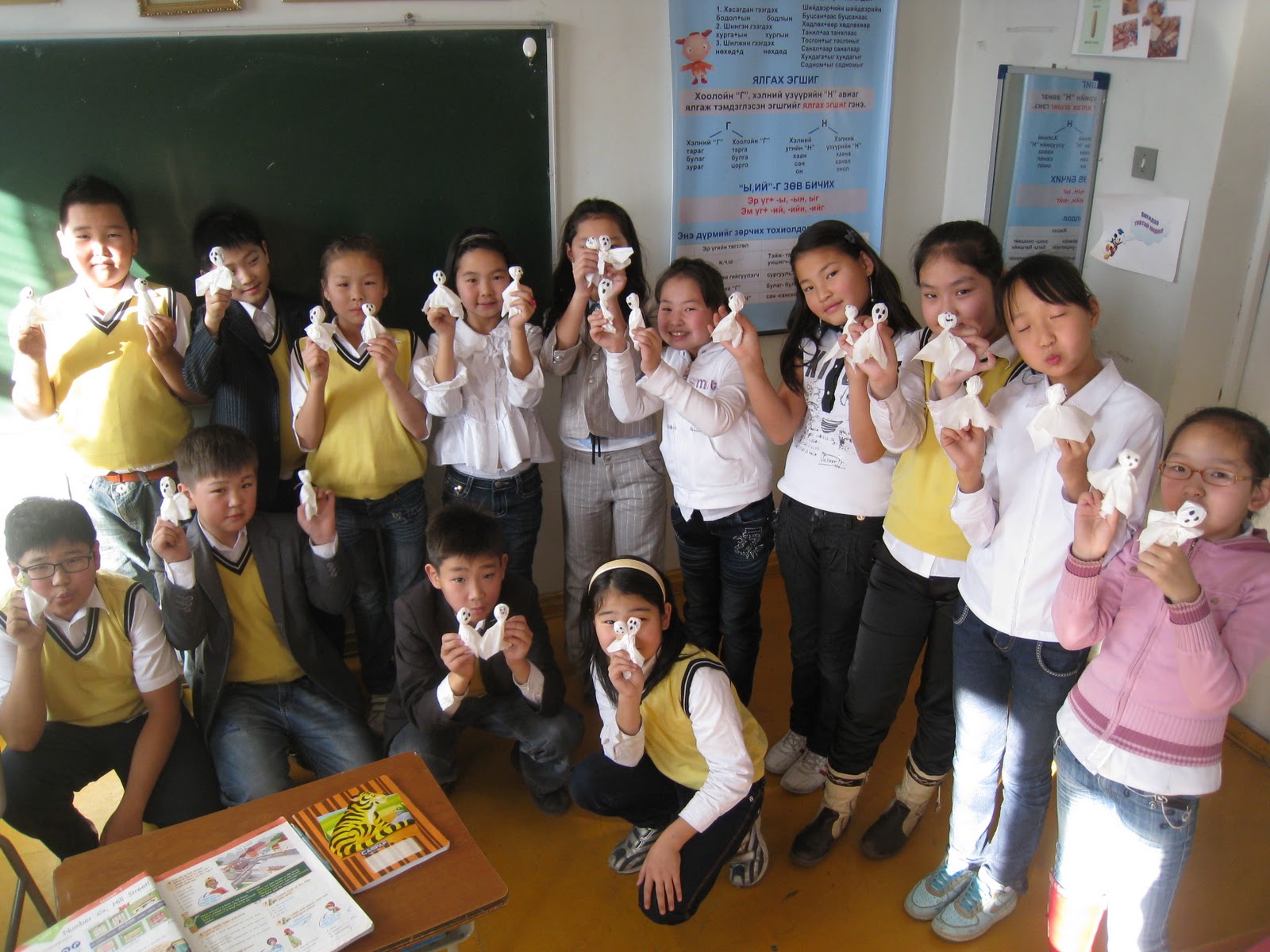
This was our final lesson before Halloween, so we had a Halloween craft lesson.  All grades made ghosts out of Kleenex.  Grades 1 and 2 made construction paper Jack-o-lanterns, while B1, B2, and C3 classes made masks.  Here are a few photos from the day, and see the slideshow on the right sidebar for more photos.  The slideshow only shows 110 photos, but I have 220 photos, in all.  Click on any one of the photos to see a bigger copy of the picture, and to see all the photos.  Thanks.


Halloween Riddle #4

What does a vampire do when he gets a cold?

Wednesday, October 27, 2010

Thursday, 28 October, 2010: A1, A2, C1, and C2 Classes

Today, our last lesson together before Halloween, was a Halloween craft lesson.  We made ghosts out of Kleenex (and toilet paper, when my Kleenex supply ran low), and we also made Halloween masks out of coloured paper.  Here are some photos of the Halloween Craft lesson we had.  I took a lot more photos than just these, though (see the slideshow on the right-side bar).  I know the pictures in the slideshow are small, but if you click on any one of the photos in the slideshow, you will be able to see a bigger version of the pictures.


Halloween Riddle #3

What is worse than being a 1000-pound witch?

Tuesday, October 26, 2010

Wednesday, 27 October, 2010: A3 Class

In this lesson, I tried to check your homework from last time, and found that only one person had completely done the homework (congratulations, Altantogos, for doing all the homework!) and only one other person had even half finished the homework (thank you, Khulan, for doing some of the homework).  This led Marie to tell you about the plan for next term: for this first term, you were lucky because there were no grades in my class, but for next term, I will be giving you guys grades based on class participation (bringing your notebooks/books to class, taking notes, listening to the lesson, following instructions), homework (whether your homework is done and complete), tests (you will have some tests next term), and assignments (I will give one or two assignments), so hopefully this will be enough of an incentive for you to take English class a little more seriously next semester.

Then, we moved on and started talking about family trees.  We looked at a family tree in our textbook of a boy named Peter, and we talked about Peter's family (Who is Peter's grandmother? Who's Caroline? etc).  Then, for fun, Marie drew her enormous family tree on the chalkboard, we found that Marie has 22 aunts and uncles, 33 cousins, and about 33 second cousins, as well.  

We also looked at some family riddles:

My sister is my mother's daughter.
My father is my grandfather's son.
My mother is my father's wife.
My uncle is my aunt's husband.


This reminded Marie of a riddle in a short story called "Juan Verdades", by Joe Hayes.  In this story, Juan Verdades, an extremely honest character, picks all of the apples from his boss's prize apple tree and gives them away to the girl he loves.  When it comes time to admit to his boss what he did, here is what he says:


"A fool picked the apples and gave them away.  The fool is my father's son.  If the fool had a child, he would call his father "grandfather".  I don't have any brothers."


Challenge:  Can you figure out this family riddle?  Who is the fool?  Is it:
a) the speaker? 
b) the person being spoken to?
c) the father?
d) some other person we don't know about?


Don't forget your homework!
Remember the enourmous family tree Marie showed you?  Well, now it's your turn to show me your family tree.  Include your grandparents, your parents, your aunts and uncles, your cousins, and your brothers and sisters!

Wednesday, 27 October, 2010: A2 Class

In this lesson, we reviewed how to talk about fixed arrangements by using the present continuous (remember the listening exercise we did?).  Then, we moved on to a new page in the book and Marie attempted to have a discussion about emails, how often we send emails, who we send emails to, and why we send emails, but you guys did not seem interested in following the discussion or the lesson.  This led to Marie telling you guys about the new grading scheme for next term.  For this first term, you were lucky because there were no grades in my class, but for next term, I will be giving you guys grades based on class participation (bringing your notebooks/books to class, taking notes, listening to the lesson, following instructions), homework (whether your homework is done and complete), tests (you will have some tests next term), and assignments (I will give one or two assignments), so hopefully this will be enough of an incentive for you to take English class a little more seriously next semester.

Don't forget your homework!
Khisigsuren, Joy, Rose, and Temuulen all have to create a gmail account.  Just go to www.gmail.com, click the button that says "Create Account", and follow the instructions.  All other students already have email addresses, so everyone (including Khisigsuren, Joy, Rose, and Temuulen, after they have created their email addresses) must write me an email at marieinmongolia@gmail.com.  You can write about anything you want.  You can tell me about your family, you can tell me about your fixed plans for the weekend, you can ask me a question about class, but you must write an email!

Wednesday, 27 October, 2010: C1 Class

In this lesson, we looked at two letters from Eddy and Oscar.  Some grammar that came up when we looked at the letters were:

Lin's got = Lin has
Cindy's got = Cindy has
I've got = I have

Some vocabulary that came up in this lesson was:

computer --> the big, heavy monitor that and tower that stays on your desk
laptop --> a smaller, lighter, portable computer that you can carry around with you
notebook  (computer)--> like a laptop
centre (of town) --> the middle of town
python --> a very big snake, like in the following picture:

Don't forget your homework!
Finish the writing assignment from page 15.  Pretend that you are writing a letter to a friend and telling your friend about a new friend that you made.

Wednesday, 27 October, 2010: C2 Class

In this lesson, we reviewed the words "opposite", "next to", and "between".  Then, we practiced asking and answering questions using "Is there":

Is there a bank opposite the cinema? --> No there isn't.  There's a supermarket opposite the cinema.
Is there a house between the bank and the restaurant? --> Yes, there is.
Is there a station next to the bank? --> No, there isn't.  there's a house next to the bank.

Don't forget your homework!
Ha!  Luck!  You don't have any homework today.

Halloween Riddle #2

Why was Dracula put in jail?


He tried to rob a blood bank!

Vocabulary

It's time for twelve new vocabulary words that American students are actually expected to know (all taken from McGraw Hill's 400 Essential SAT Words).  Challenge yourself!  See if you can learn some of these words and use them in a conversation or in an essay!

ephemeral (Adj.)  Not real or authentic for any length of time; fleeting
The thrill of tearing down a hill on a sled is ephemeral because soon you have to get off the sled and climb to the top of the hill again.

erroneous (Adj. N: erroneousness  Adv: erroneously)  Mistaken or untrue
Erroneous information led the police force to pursue the wrong subject.

evanescent (Adj.  N: evanescence  V: evanesce)  Vanishing or likely to vanish; without much substance
One's dreams are often evanescent, because, soon after waking, most people forget the details.

fallacy (N.  Adj: fallacious)  (1) a false notion; (2) a rhetorical flaw in an argument; (3) an untruth.
(1) It is a fallacy to think black cats bring bad luck.
(2) There was such a glaring fallacy in the lawyer's argument that it was no surprise that he lost the case.
(3) Some pessimists believe that true love is a fallacy; it just doesn't exist.

fantasy (N.  Adj: fantastic, fantastical  V: fantasize)  A creation of the imagination; an imagined event; a dream
Tolkien is the author who introduced the reading public to a genre of fiction known as fantasy novels.

fleeting (Adj.  Adv: fleetingly)  Passing quickly; ephemeral
We caught a fleeting glimpse of the squirrel as it scampered away from the bird feeder.


hallucination (N.  Adj:  hallucinatory  V:  hallucinate)  (1) A false or mistaken idea; a delusion; (2) A multisensory experience with no external stimulus, often drug-induced
(1) After my grandfather's death, my grandmother experienced some strong hallucinations in which her late husband talked to her.
(2) While coming out of the anesthetic after my surgery, I kept having very strange hallucinations.

illusion (N.  Adj: illusionary)  An erroneous perception of reality; a fantastical plan.
Chaltu had a strong illusion about the possibility of someone following her.

imaginative (Adj)  Havine a lively, creative mind; creating fantastic dreams
imaginary (Adj.  Adv: imaginatively V: imagine)  Not real, from the imagination
It is not unusual for a child, especially an only child, to be very imaginative and to create an imaginary friend.

imprecise (Adj.  N: imprecision  Adv: imprecisely)  Not precise; not exact or sure
Since Mallory's answer was rather imprecise, Matthew's response sounded intelligent and specific by comparison.


inaccurate (Adj.  N: inaccuracy. Adv: inaccurately)  Mistaken or incorrect; not accurate.
Abraham stood by his beliefs and principles whether they were inaccuarate or exact.


mirage (N)  (1) soemthing that is illusory or insubstantial; (2) an optical phenomenon that creates the illusion of water.
(1) Thomas always visualized the mirage of a six-figure income.
(2) A typical mirage is a green and lush oasis in the middle of the desert.

Monday, October 25, 2010

Tuesday, 26 October, 2010: Grade 2 and 3

In this class, we reviewed the letters of the alphabet and the sounds that each of the letters make.  Then, we practiced reading some words with the short /o/ sound.  Some words we practiced in class are:


fox / box / pot / mop / fop / top / rot / lot / rom / pom / cot / con / cog / cop / bog / bop / cost / dogs

Tuesday, 26 October, 2010: C3 Class

In this class, we reviewed and practiced how to give phone numbers.  We practiced asking and answering the questions, "What's your phone number?" and "What's Dolgoon's phone number?"


We reviewed how to ask "What's this?" and how to say if something belongs to someone:
It's Dolgoon's notebook.
Then we learned the phrase, "It's very nice!"

We reviewed the family words: dad, mom, grandmother, grandfather, brother, sister.  Then, we practiced talking about Masid's family:

His father's name is Akil.
His grandmother's name is Alima.

Someone asked a very important question about why we say "his" instead of "her".  It's because "his" is talking about Masid, and we know that Masid is a boy, so we need to say "his", even if we are telling about a girl in our sentence:

His sister's name is Bibi. ("his" is telling about Masid, not Bibi)
His mother's name is Laila. ("his" is telling about Masid, not Laila)

Tuesday, 26 October, 2010: B1 Class

In this class, we talked about emails, how often we send emails, to whom, and why we send emails.  We also read and talked about a girl's email in our textbook.


Some vocabulary that came up in this class was:

opening remarks --> the things you say at the beginning of a letter or email
closing remarks --> the things you say at the end of a letter or email
theme park --> like an amusement park
Don't forget your homework!
For your homework, you have to write an email to me at marieinmongolia@gmail.com
You can write this email any time before Sunday, October 31st.

Tuesday, 26 October, 2010: B2 Class

In this class, we started to review the directions: North, East, South, West, North-East, South-East, South-West, North-West.  We were meant to do a fun activity, but I noticed that half the class was not taking notes, so we wrote some notes about Canada instead (Vancouver in in the West. Prince Edward Island is in the East., etc) and then, based on the notes we took, we practiced finding the cities on a map of Canada which I drew on the board. 


Next time, if we are trying to do a fun activity, please do not spoil it by not following directions!

Do not forget your homework!
Today, you do not have any homework, but please be sure to do it in the future!

Halloween Riddle #1

Okay, students, something you might not know about your teacher yet: I get very excited about holidays.  As most of you know, October 31st is Halloween, which is a lot of fun.  I'm going to post one riddle a day, until Halloween Day.  I hope you enjoy them!


Sunday, October 24, 2010

Monday, 25 October, 2010: B1 Class

In this lesson, we learned what a suggestion is and we practiced giving some suggestions:

Why don't we go to a movie?
What about going to a movie?
Let's go to a movie.
Shall we go to a movie?

Marie thinks it sounds weird to say "Shall we go to a movie?"  She prefers the word "should"-- "Should we go to a movie?", although if you want to say "shall", it definitely is okay to use "shall", as we can see in these movie posters:


We also learned some different ways to reply to a suggestion.  If our reply is "yes", we can say:
Sure.
Okay.
Let's do it.
I'd love to.
Sounds good.
Sounds great.

If our reply is "no", we can say:
Sorry, I can't.
I'd love to, but.....
I'm busy.
I'd rather not.
I don't want to.

Don't forget your homework!
Got ya lookin!  You don't have any homework today, lucky kiddos!


Monday, 25 October, 2010: A1 Class

In this lesson, we reviewed some conversation exchanges.  Then, we moved on and read three emails for three different teenagers about their problems.  The problems were:

Sally is desperate because she gained a lot of weight and doesn't know what to do.
Danny is lonely because he doesn't fit in at school.
Tom is shy because he's afraid of making a fool of himself.

I also pointed out that because-clauses are special because, after the word 'because', you can just put a normal complete sentence:

Sally is desperate because she gained a lot of weight and doesn't know what to do.
Danny is lonely because he doesn't fit in at school.
Tom is shy because he's afraid of making a fool of himself.


In pairs, we practiced talking with each other in English and discussing what Sally, Danny, and Tom could do about their problems and giving our justifications (reasons) for our suggestions. Next time, we will talk more about our suggestions for these three problems.

Don't forget your homework!
Today, you guys don't have any homework, but please don't forget to bring a memorable photo to school on Saturday and have a few words to share about your photo!  Even if you don't bring a photo to school, I'll make you come to the front of class and tell us a short story, so please bring a picture!

Monday, 25 October, 2010: A3 and B2 Classes

Lesson 1:

In this lesson, learned the directions: North, East, South, West, North-East, South-East, South-West, and North-West.


We also reviewed how to ask and answer where a city is:

Where's [CITY]? --> Where's Bayan-Olgii?
It's in [COUNTRY]. --> It's in Mongolia.
Where exactly? --> Where exactly?
It's in the [COMPASS DIRECTION]. --> It's in the West.

Don't forget your homework!
Draw a map of Mongolia and write sentences about some of the towns/landmarks in Mongolia.

Tuesday, October 19, 2010

How to post a comment on blogger

It has come to my attention that some of the students have tried to post comments on this blog (yay!) but found it extremely difficult (boo-urns!).  I think the easiest way to post a comment on this blog is probably to create your own blogger account.  Here's what you have to do:

  1. Create a gmail account.  The only email account that blogger will allow you to create a blog with is gmail, so you must create a gmail account.  To do this, go to www.gmail.com and click on the button that says "create account"
  2. Then, go to www.blogger.com and click on the orange button that says "Create a blog".  Follow all the steps needed to create a blog.
  3. Once you have created a blog, you can follow blogs.  You can choose to follow my blog and Altaa-teacher's blog.  Then, everytime you log onto blogger.com, you will see if we have updated new posts.  Also, you should be able to make comments on our posts if you are signed in to your blogger blog. 
  4. Finally, once you have created a blogger account, you can use your blog to write (in English or Mongolian) about anything you want.  Have fun with it!

20-23 October, 2010: A2 Class

Lesson 2
In this lesson, we defined what a suggestion is:

suggestion (N) "telling someone that maybe they should do something"

We looked at a few different ways to make suggestions and some possible positive and negative responses to the suggestions:

Why don't we go out on a date?
What about going out on a date?
Would you like to go out on a date?
Let's go out on a date.
Shall we go out on a date?  (But Marie doesn't like this one.  She thinks it sounds hoity-toity, and she suggests saying "should", instead, if you really want to phrase your suggestion like this:)
Should we go out on a date?

Notice that the verb that follows the suggestion stem is always in the base form (the most basic form, such as go, eat, do, take, etc), except for after the stem "What about...?", when the verb is in the progressive form (going, eating, doing, taking, etc). 

If someone makes a suggestion to you and your answer is "yes", here are a few ways you can respond:

That's a good idea.
Sure, I'd love to!
Why not?
Sounds good.
Sounds great.
Let's do it.


If someone makes a suggestion to you and your answer is "no", here are a few ways you can respond:


Sorry, I can't.
I'm afraid I can't.
I'd love to, but....
Sorry, I'm busy.

We spent the rest of class practicing making suggestions with our partners.


Lesson 1

In this class, we reviewed the present continuous.  We did an exercise in our books based on "Fiona's" week in which we practiced asking and answering questions about Fiona's week.

Example: Is Fiona getting a present for her mom's birthday on Tuesday? --> No, she isn't.  She's getting it on Wednesday.
Is Fiona eating out with her parents on Wednesday? --> Yes, she is.

We also practiced talking with a partner about what are plans are for the upcoming weekend using the present continuous.


20-21 October, 2010: C1 Class

Lesson 2

In this lesson, we reviewed how to describe people.  We learned the difference between asking what someone looks like and what someone is like.


Example: What does Tuguldur look like? (you should tell about his physical qualities like his height [short/tall], weight [slim/chubby], hair, and eyes)
What does Tuguldur look like? --> He is tall and slim and he has dark hair and brown eyes.
What is Tuguldur like? (you should tell about his personal qualities, like his intelligence, humour, etc)
What is Tuguldur like? --> He is kind, polite, and intelligent. 

We also reviewed the difference between "he/she is..." and "he/she has...".  If we say "he/she is...", we have to continue with something about their height, weight or their personal attributes (kind, funny, polite, etc).  If we say "he/she has...", we have to continue with something about their eyes or hair.  If we say "Tuguldur is dark hair", we are saying that "Tuguldur = dark hair", that he is just one big blob of dark hair and nothing else, so please remember and practice this distinction!

We finished the class by doing a class survey, which was a lot of fun.


Lesson 1

In this lesson, we reviewed and practiced how to describe people.  


Remember that we use "have" + hair and eyes, and "be" + height and weight,

Example: I am short and chubby and I have long brown hair and blue eyes.

If we say "BE" + hair or eyes (as in "I am blue eyes"), it sounds wrong because it sounds like I = eyes, that I am just two big eyes, and that I don't also have a nose, a mouth, ears, arms, legs, etc.  People have eyes the same way they have a t-shirt, a jacket, a hairstyle, or a book.


We also noticed that when we describe someone's hair, there is a special order we need to use:

length > type > colour

Example: long curly dark hair, short straight blond hair, short, wavy dark hair, etc

We also have to be careful because fair hair only describes hair that is extremely light in colour, such as hair that is blond, red, or possibly extremely light brown (but I have yet to see someone in Mongolia who has fair hair, so we can all safely say that we don't have fair hair).

One more point to note is that we never say that we have "black eyes", no matter how dark brown our eyes are.  Even if our eyes are extremly dark brown, we will always say that we have "brown eyes."

Example: I have black eyes. (wrong) --> I have brown eyes. (correct)

20-21 October, 2010: C2 Class

Lesson 2

In this class, we reviewed the direction words (left, right, next to, between, and opposite).  We also reviewed the new vocabulary from last lesson (record shop, bank, station, supermarket, restaurant, and hotel).  We then learned the sentence structure "The [PLACE] is on the left", and we practiced using a map in our book, as well as a map of Seoul street, which Marie drew on the chalkboard, eg:


The theatre is on the left.
The embassy is on the right.
The record shop in on the right.
The restaurant is on the left.
etc.


Lesson 1

In this lesson, we reviewed how to introduce ourselves and say where we come from.  We learned a song/chant, and we added one more stanza saying about ourselves.  It went like this:

My name is [NAME],
And I'm from Mongolia.
How are you, how are you,
And how are you today?

Then, we moved on to Unit 2, in which we learned some words for giving directions.

turn left* --> turn towards your left side
turn right* --> turn towards your right side
next to --> beside
between --> has two things on either side of it
opposite --> across from something

I also taught the kids my special trick for remembering left from right.  Stick just your thumb and forefinger out.  The one that makes an "L" shape is your left hand ("L" is for 'left').  The one that makes a backward "L" is your right hand.

We also learned some vocabulary in this lesson:

record shop --> where you buy CDs or music
bank --> where you keep your money
station --> where you catch a train or bus
supermarket --> where you buy food to cook at home, supplies for your home, and things like soap and shampoo
restaurant --> where you go to eat a meal which somebody else cooks for you
hotel --> where you sleep when you are on vacation

Monday, October 18, 2010

19-23 October, 2010: Grade 2 and 3

This week, we are continuing to review the ABCs, and we are practicing words with the short /i/ sound.  Some words we are learning to read and write are:


kid / sit / lit / pig / rig / big / bid / bib / bid / kit / fig / fin / pin / wig / dig / rid / rim / tix / six / win / lisp / list / limp / risk

19-23 October, 2010: C3 Class

Lesson 1

Thank you for finally sitting in your seating plan today, C3 class!!  I appreciate it, and it meant that our class went much smoother today.


In this lesson, we reviewed the possessive determiners, which are:

my --> to talk about something which belongs to the person speaking
your --> to talk about something which belongs to the person you are speaking to
his  --> to talk about something that belongs to just one boy
her --> to talk about something that belongs to just one girl
its --> to talk about something that belongs to just one thing
our --> to talk about something which belongs to the speaker and one or more other people
your --> to talk about something which belongs to several people to whom you are speaking
their --> to talk about something which belongs to several people you are talking about

Examples:
That's me and that's my mother.
Thats you and that's your brother.
That's Blake and that's his dad.
That's John and that's his mom.
That's Danielle and that's her daughter.
That's Jenna and that's her dog.
That's a bird and that's its nest.
That's a chicken and those are its eggs.
That's us and that's our classroom.
That's you guys and that's your teacher.
That's Ideree and Odonzaya and that's their mother.

Sunday, October 17, 2010

18-21 October, 2010: B1 Class

Lesson 3

In this class, we reviewed the present continuous.  We did an exercise in our books based on "Fiona's" week in which we practiced asking and answering questions about Fiona's week.

Example: Is Fiona getting a present for her mom's birthday on Tuesday? --> No, she isn't.  She's getting it on Wednesday.
Is Fiona eating out with her parents on Wednesday? --> Yes, she is.

We also practiced talking with a partner about what are plans are for the upcoming weekend using the present continuous.  After we finished partner-talking, we each took a turn coming up to the front of the class to tell the class about our fixed plans for next weekend, next summer, or next month.

Lesson 2

In this lesson, we reviewed the present continuous, which looks like this:

BE + VERBing --> I am writing a blog.

Then, we learned a very special form of the present continuous, which looks like this:

BE + GOING TO + VERB --> They are going to eat buuz for lunch.  

We use this form of the present continuous to talk about future plans or intentions.  We spend the rest of the class practicing the present continous.

Towards the end of class, we also learned that Marie will not tolerate note-passing in class, and we learned about how, when she catches you passing notes, once she learns to read Mongolian, she will read your notes out to the entire class.  Until Marie learns to read Mongolian, however, Marie will let Bayaraa read your notes out to the entire class, so consider this fair warning! 

Lesson 1

In this class, we learned the terms "party animal" and "home bird" (although Marie is certain that in North American English, we actually say "homebody"):

a party animal --> a person who really likes to party
a homebody --> a person who prefers to stay at home

We also learned some other vocabulary words for attributes and decided whether they would be more likely to be found in a party animal or in a homebody:

outgoing --> not afraid to talk to new people
sociable --> enjoys talking with people
quiet --> does not say much, and when a quiet person does talk, they do not talk loudly
popular --> is liked by everybody and has many friends
shy --> timid; afraid to talk to new people
friendly --> nice and kind to everybody

Then, we took a short quiz to figure out whether we are party animals or homebodies (Marie is definitely a homebody, even though she loves to travel the world).  Some vocabulary that came up in the quiz is:


wedding reception --> the meal, dance, and party after two people get married
film --> movie
comfortable --> being in a state of mental or physical comfort
comfort --> feeling good

18-22 October, 2010: B2 Class

Lesson 3

In this lesson, we reviewed the letter to the pen pal and the structure.  Then, we answered some questions about ourselves (How old are you? Where exactly are you from? What's your best friend's name? What year are you in at school? and What are some of your favourite things?).  Then, we took turns telling the class our answers to these questions (in complete sentences).  


**Homework**
Imagine you have a pen pal.  Using your answers from the questions we talked about in class, and using the same form as the letter on page 14, write your own letter to a pen pal.


Lesson 2
In this lesson, we reviewed how to ask and answer where people come from.  I told the class about my friends Frank and Roland and we asked and answered:

Where's Frank from? --> He's from Hawaii.
Where's Roland from? --> He's from Germany. 

After that, we did a short speaking activity in which we had to practice asking and answering where people come from.  When we finished the speaking activity, we had to group people according to the language which they speak based on the countries they come from.  The countries and languages were:

Australia --> English
USA --> English
Germany --> German
Austria --> German
Spain --> Spanish
Mexico --> Spanish 

At the end of the lesson, we reviewed capitalization.  Remember that the first word of a sentence is always capitalized.  So is the word "I", as are the first letters in people's names, in cities, and in countries.  Then we read a pen pal letter and corrected any capitalization errors.

i am marie. --> I am Marie.
we live in mongolia. --> We live in Mongolia. 
I like ulaanbaatar. --> I like Ulaanbaatar.  

Lesson 1


In this class, we reviewed the stress and pronunciation for some words and nationalities.  The bold syllable in the following words are the ones that get stressed (remember that the stressed syllable is the syllable that sounds louder or that gets said with more force):

Italy
Italian
Brazil
Canada
Poland
Austria
American
Mexico
Canadian
Brazilian
Chinese
Russia
Japan

We also learned how to use the verb BE in the negative form (with the word "not"):

I am not = I'm not --> I'm not Russian!
You are not = You're not  = You aren't --> You aren't Chinese.
He is not = He's not = He isn't --> He isn't from Turkey.
She is not  = She's not = She isn't --> She isn't listening.
It is not = It's not = It isn't --> It isn't from Canada.
We are not = We're not = We aren't --> We aren't checking this blog regularly.
They are not = They're not = They aren't --> They aren't passing notes in class.

Afterwards, we learned how to make a question with the verb BE.  To make a question with the verb BE, all you have to do is remember to put BE at the beginning of the sentence and put your subject after it.  So,

Altaa-teacher is from Mongolia. --> Is Altaa-teacher from Mongolia?
Marie-teacher is Canadian. --> Is Marie-teacher Canadian?
Italian shoes are really nice. --> Are Italian shoes really nice?

At the end of class, we learned how  to ask and answer questions about where people come from.  I told the class about my friends Linda, Leone, Mecca, Maria, Dongwoo, and Mohammed, and we practiced asking and answering where they come from:

Where's Leone from? --> She's from Sri Lanka.
Where's Linda from? --> She's from Ecuador.
Where's Mecca from? --> She's from the USA.
Where's Maria from? --> She's from Denmark.
Where's Dongwoo from? --> He's from Korea.
Where's Mohammed from? --> He's from Kuwait.